
As AI infrastructure scales, one of the biggest constraints is no longer just compute — it is cooling. Behind every hyperscale deployment, there is a mechanical and thermal challenge that directly impacts uptime, operating cost, energy efficiency, and long-term scalability. And as large AI data centers push toward higher power densities, the companies that solve cooling well will capture an outsized share of the next infrastructure wave.
At Workflow, we have supported strategic analysis in this space, including work relevant to how major advisory and consulting groups evaluate data center infrastructure decisions. This includes the same kinds of technical and commercial questions firms such as McKinsey & Company and Bain & Company increasingly examine as AI infrastructure becomes a board-level priority.
This is not just an HVAC story. It is an AI infrastructure economics story.
Cooling is now a first-order AI infrastructure problem
The market is waking up to a simple reality: if compute density rises faster than cooling efficiency, then cost, deployment speed, and reliability all suffer. For frontier AI deployments and large-scale inference clusters, thermal management is becoming one of the most important enablers of infrastructure growth.
That is why cooling vendors are no longer being evaluated as “mechanical equipment suppliers.” They are being evaluated as strategic infrastructure partners.
For operators, developers, and investors, the key question is no longer just:
“Who can cool the facility?”
It is now:
“Who can cool it efficiently, reliably, at scale, and without breaking the economics of the deployment?”
Why cooling economics matter more than ever
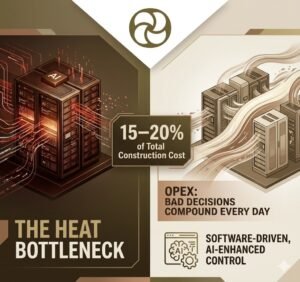
A 100MW AI-capable data center can carry an enormous mechanical burden. In large facilities, HVAC and mechanical systems can represent roughly 15–20% of total construction cost, making them one of the most capital-intensive components of the build. Within that, chillers, heat rejection, air handling, pumps, controls, and distribution all play a critical role in lifecycle cost and uptime.
What makes this especially important in the AI era is that cooling is not just a CAPEX issue — it is a compounding OPEX issue:
- poor cooling design increases annual power consumption
- inefficient systems drag down PUE
- service complexity raises operational risk
- non-modular systems slow expansion
- weak thermal control limits future rack density
In other words, bad cooling decisions become expensive every single day.
Why vendors like Modine are gaining attention
One reason Modine Manufacturing Company has been drawing attention is that the market increasingly values suppliers who can combine thermal performance, energy efficiency, modularity, and scalable manufacturing.
From a strategic standpoint, Modine’s positioning is attractive because it aligns with what hyperscale and AI infrastructure developers care about most:
- strong part-load and full-load efficiency
- lower lifecycle cost, not just lower upfront bid price
- modular deployment flexibility
- serviceability and uptime support
- sustainability and refrigerant compliance
- scalable manufacturing readiness
That combination matters because hyperscale infrastructure is rarely built all at once. It is phased, capacity-sensitive, and highly exposed to execution risk. Vendors that can support expansion without disruption gain a major edge.
The real buying decision is total cost of ownership
In data center cooling, buyers do not win by selecting the cheapest line item. They win by selecting the system that performs best over time.
A proper selection process usually evaluates vendors across a weighted mix of criteria such as:
- thermal efficiency and capacity performance
- lifecycle energy and maintenance cost
- delivery timing and modular scalability
- service footprint and warranty support
- environmental compliance and local content
That is exactly how sophisticated infrastructure buyers think. The “best” cooling vendor is usually not the one with the lowest bid — it is the one that best balances performance, resilience, economics, and deployment practicality.
This matters even more in AI because infrastructure utilization can be highly variable. Facilities often see fluctuating cooling demand across training, inference, and partial load states. That means part-load efficiency is not a minor engineering detail — it is a financial lever.
Why competitors cannot easily replicate cooling leaders
This is where the market often underestimates the moat.
Strong cooling vendors are hard to displace not because “a chiller is just a chiller,” but because the real advantage often comes from the system around it:
- decades of thermal engineering expertise
- field-proven reliability across demanding environments
- manufacturing capacity and delivery confidence
- AI-enhanced control systems and optimization layers
- customer trust in mission-critical deployments
- service network readiness and parts availability
These are not things competitors can replicate overnight.
In the AI infrastructure era, a vendor that can demonstrate both equipment performance and operational confidence becomes much more valuable than one that merely looks competitive on paper.
AI is also changing how cooling systems themselves are managed
One of the most important shifts happening now is that cooling is becoming increasingly software-driven.
The future is not just “better chillers.” It is:
- smarter thermal control
- dynamic optimization across load profiles
- predictive maintenance
- real-time system tuning
- digital twins for cooling plant performance
This is where AI becomes recursive: AI infrastructure increasingly depends on AI-enhanced infrastructure management.
That creates a new class of advantage for companies that can integrate mechanical systems with intelligent controls, plant analytics, and operating optimization. Over time, this may become one of the most defensible differentiators in the cooling stack.
What this means for investors and operators
The cooling market is no longer a background category in the AI buildout story. It is becoming one of the most important strategic enablers of compute deployment.
For investors, this means thermal infrastructure names deserve much more attention than they historically received.
For operators and developers, it means cooling decisions should be treated as core strategic infrastructure decisions, not procurement afterthoughts.
And for enterprises trying to understand the next phase of AI infrastructure, it means one thing clearly:
The next winners in AI will not just be determined by chips and models.
They will also be determined by who can physically support them.
Final take
As AI clusters become denser, more power-hungry, and more expensive to operate, thermal infrastructure is moving from the background to the center of the story.
Cooling is no longer just about temperature control. It is about:
- economics
- deployment speed
- uptime
- scalability
- sustainability
- competitive advantage
That is why this market matters — and why the companies solving it well are likely to matter much more over the next several years.